Why this exists
I did not build Opponentura to make me take less risk
Business requires risk. I wanted a separate process that makes it clearer which risk I am actually taking, what the decision rests on, and what fact should make me change course.
Who I am
My name is Vadim Kamashev, and I am the founder of Opponentura.
I trained as an economist-mathematician; the programme was called "economic cybernetics", which in plain words is the science of control through feedback. I spent ten years as CFO of a large agricultural holding, then went into business for myself, and for more than twenty years now I have run a retail and import business: premium oral-care products and jewelry, sold through my own stores.
I currently have several active projects. Some have worked and ended profitably; others had to be closed at a loss. Very roughly, I think of my own entrepreneurial record as about 50/50. That is not a statistic I use to prove anything. The point is almost the opposite: I am not presenting Opponentura from the position of someone who has discovered a formula for always being right. I have made good decisions and I have made expensive mistakes with my own money.
I did not build this project out of comfort. Six months ago I started building AI tools myself and automating my own processes. Useful stuff, but its main flaw showed up fast: AI agrees with you. Bring it a plan and it praises the plan. Bring it doubts and it agrees with the doubts. That is how you end up solving the wrong problem perfectly.
I did not like that. Owners rarely get real pushback even without AI; everyone around them benefits from saying "yes". I am a doubter by temperament, I look for weak spots in myself first, and negative feedback is what I have always lacked. My one long-standing rule: sleep on it before a big decision.
I spent a long time trying to make models argue with me. It did not work until I understood that the problem was not the model but the construction. What was needed was a procedure: several roles, each obliged to find a weakness, an argument, an on-the-record vote — and no one benefiting from agreement.
That is how Opponentura came about. First for myself, then for everyone. It takes your decision, runs it through a panel and hands back a document: what was missed, what to check first, under what conditions to change course. That night before the decision becomes useful: while you sleep, the decision goes through a review you would not have thought of yourself. That matters to me, and to any business owner before an important decision. And not only to business owners.
The story: why I built this — expand
“Does anyone actually want this?”
A friend recently asked me a fair question: “Are you sure people want a product that challenges their decisions? You naturally question things. Many executives are paid to be decisive, trust their experience and move.”
I partly agree. Opponentura is not for everyone, and certainly not for every decision.
But you do not need to enjoy criticism. Doubt is not a virtue by itself, either. A leader who never commits is not better than a leader who never revisits an assumption.
The more useful test is the decision: how costly it is to be wrong, how hard it is to reverse, and how much still depends on assumptions rather than established facts.
Business requires risk
There is an obvious objection to a system built to look for failure modes: won’t it simply talk an entrepreneur out of doing anything?
It should not.
Entrepreneurship means acting with incomplete information. Money is committed today without a guaranteed result tomorrow. That is normal.
One situation is: I understand the downside, I know the key assumptions, and I still decide, “Yes, I accept this risk. The potential outcome is worth it.”
A very different situation is believing I am taking one risk when the decision actually depends on an assumption I never tested, the downside is larger than I thought, or the next commitment makes the decision much harder to reverse.
Opponentura is not designed to make business risk disappear. It is designed to make the risk you are taking explicit.
What hindsight can and cannot tell me
Looking back at projects that failed, I do not tell myself: “If Opponentura had existed, I would never have lost money.” That would be false.
In some cases I would still have taken the risk and might still have lost. That is business. But there are projects I would not enter today, projects I would enter on different terms, and projects where I would first run one inexpensive test before making the large commitment.
That is a realistic promise for me: not removing uncertainty, but seeing the actual bet earlier.
Why one more opinion was not enough
I already have partners, employees, lawyers, advisers and my own experience. The problem is not that nobody is smart or nobody disagrees.
The problem is structural. After a team has worked inside the same decision for long enough, some assumptions become part of the shared frame. People can debate the options intelligently while leaving the frame itself untouched.
What I wanted was not another adviser and not a machine required to say “no”. I wanted a separate process with a different mandate: test the frame, the assumptions, the downside and the conditions that should change the decision.
What I want from a review
After a good review I need three practical answers:
- What I may have missed.
- What to verify first — ideally quickly and cheaply, before the expensive or irreversible step.
- Under what conditions to proceed, what to change, or what to do instead.
Criticism without a next action is an incomplete result.
The process and the “O-18” method, briefly
Opponentura runs on large language models. Inside are AI roles, not a panel of living experts; they do not make the decision for you.
The value for me is in the process. What gets tested is not only the chosen move but how the question was posed in the first place. The decision is first examined in separate passes, then the real disagreements are argued out, external facts are checked separately, and before the report is sealed even the proportionality of the criticism is reviewed.
Inside the “O-18” method are 18 review procedures for different types of decision error. Four are always mandatory; the rest are assigned to the case. The number 18 is not the point. The point is that the decision is not tested the same way over and over.
Why I started with myself
The first plan I put through the process was Opponentura itself. The result was REVISE.
The value was not the criticism as such. It was that things became concrete: what to change, what to test, and what would have to be true to go ahead. The original sealed PDF remains public and unchanged, with the same hash it had when issued.
The report about our own launch is published on the Russian site (in Russian); English samples are on the samples page.
Why I made it available to others
I first built Opponentura for decisions of my own. The reason I made it available to others is broader.
Serious consequences do not happen only because people are reckless. A capable person can spend so long inside one model of a situation that the limits of that model become hard to see.
I cannot promise that Opponentura will prevent a bad decision. What I want is simpler: before a costly or hard-to-reverse commitment, give the decision-maker one more chance to notice what is invisible from inside their own frame.
If that second pass sometimes leads to one better question, one cheap test, a changed term or a decision not to proceed, then Opponentura has done something useful.
Who reads what, and who decides
I do not read the reports, and I am not part of the review itself. What I will not claim is the absolute “nobody ever sees anything”, because it would not be true. There are exactly two routine paths where I see what you wrote:
- Support. Write to
/paysupportand your question and the whole correspondence come to me — otherwise there would be nobody to answer. It is stored separately from case materials. - A published sample. Only where you agreed personally and the permission is recorded in our registry.
Panel members are AI roles. If a real human guest ever sits on a panel, the report will identify them as a person.
Founder
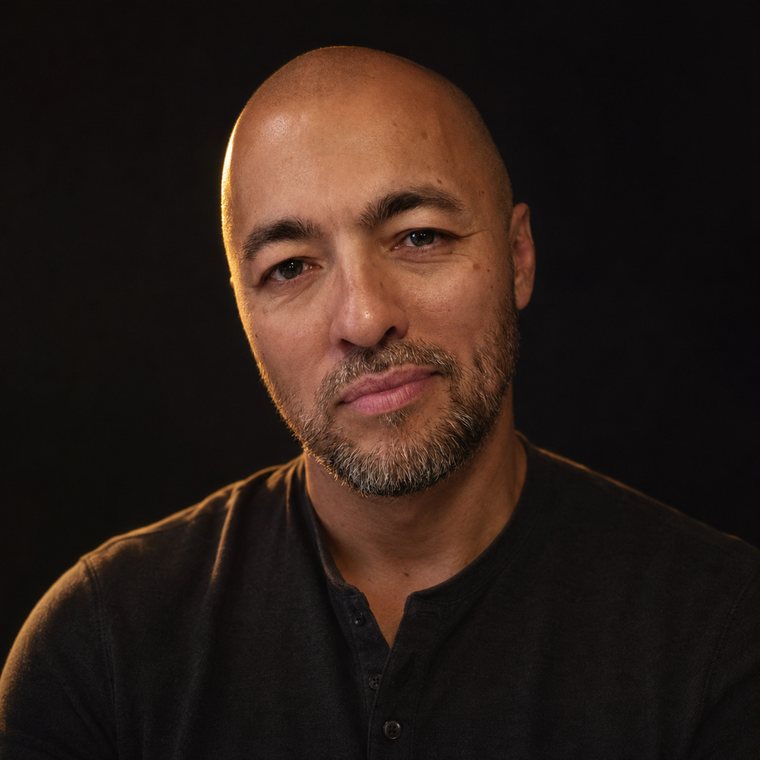
Vadim Kamashev, founder and the only person in the project — there are no hired employees. Why I built it, you have read above: not out of comfort — I do not like it when AI agrees with me.
I am not part of the hearing itself: the panel chair runs the session and I do not read the report. To write directly — @opponentura.
And about data — as a matter of principle. The line I draw is not about counters but about content: traffic sources and a few page actions are measured through Google Analytics — without cookies until you answer, in full once you allow it — with advertising features and session replay switched off, while decisions, documents and conversations never reach web analytics. You may sign up under any name and from any account — your real name is neither needed nor verified. Email is requested only so the payment platform can issue an invoice. Nobody reads the report: not me, not employees — there are no hired employees. There are exactly two exceptions, both named above: a sample published with your personal permission, and your own message to support. This is not marketing but a condition of the work: there is nothing to analyze if you cannot speak freely. Amusingly, that is exactly what the panel told me when I put my own launch plan in front of it.
Payment operator
Payment operator details — expand
Payments, invoices and refunds go through a registered individual entrepreneur, who is also the party to the Terms of Service and the recipient of payments.
| Legal form and name | Individual entrepreneur Kirill I. Aleksandrov — a partner in the project (Russian Federation) |
| TIN | 770475518824 |
| OGRNIP | 323774600519901 |
| Activity | data processing and information hosting services (Russian classifier code 63.11) |
| Taxes | special tax regime; VAT is not charged |
| Governing law | the laws of the Russian Federation |
| Contact | the
Service's Telegram bot @OPPONENTURAbot email opponentura@gmail.com — written requests |
The work happens in the bot: conversations about money are kept, so every request leaves a trace you can point back to. Email is the second channel — for people without Telegram and for paperwork: claims, “Special case” contracts and personal-data requests. Full terms are in the Terms of Service.
How we handle being wrong
A verdict is not a prophecy — it is a map of risks with check-by dates. We assume we will be wrong sometimes, and say in advance what we do about it:
- We keep a ledger of verdicts and reconcile them against how the matter actually ended. While the Service is young the sample is small — publishing accuracy percentages off a dozen cases would be passing noise off as statistics. Once the count runs into dozens, the summary will appear on this page.
- A contested fact is marked as contested. Before printing, the report passes a fact review by another vendor's engine: what is unconfirmed stays unconfirmed instead of turning into a confident claim.
- An error in an issued report is corrected by issuing a new one — with a new number and a reference to the previous document. Silently rewriting a document that is already with the recipient is impossible: they hold a file whose hash sits in our register.
- A technical failure of a hearing is our problem, not yours. The hearing is re-run or the payment is returned.
What the Service does not do
It gives no legal, financial or medical advice — this is decision-support software. It does not decide for you: the final word always belongs to the owner of the question. It does not take on the topics listed as prohibited. It never sends case content to web analytics and loads no advertising pixels — how we handle data.